

Image: Presentación de Sonia Gómez Puente, Eindhoven University ot Technology, Paises Bajos
- Actualidad
Challenge Based Education, an international conference at the heart of Bilbao
The CBE 2026 International Conference brings together experiences connecting university learning with society’s challenges
Bizkaia Aretoa hosted the International Challenge-Based Education (CBE) Conference on 27 and 28 October, bringing together Challenge-Based Learning experiences from different disciplines and educational contexts, with a focus on collaboration between universities, society and the wider territory. Euskampus Fundazioa, as a collaborating organisation of the EHU’s CBE i3lab laboratory, played an active role in organising and facilitating one of the conference sessions.
How can university learning be connected to society’s real-world challenges? What happens when students work alongside businesses, public administrations and social organisations to develop potential solutions? What learning emerges from these collaborations, and how can they contribute to transforming education and making a positive impact on society?
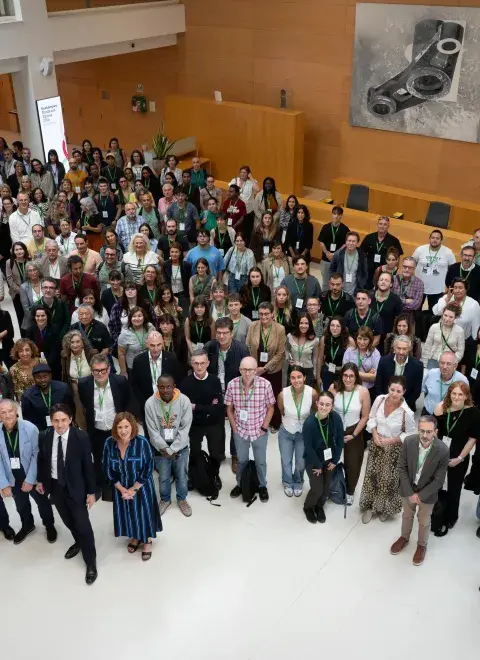
Under the theme Challenge-Based Education (CBE): Educating for Social Impact, the CBE 2026 International Conference turned Bizkaia Aretoa, in Bilbao, into a meeting point for sharing experiences, methodologies and results in Challenge-Based Learning. Over two days, lecturers, researchers, students and professionals from different fields presented projects developed across a range of disciplines and educational levels. Organised by the CBE i3lab of the University of the Basque Country (EHU), the conference addressed topics including CBE design and assessment, social impact, sustainability, educational innovation, interdisciplinarity and collaboration with external stakeholders.
The institutional opening ceremony featured Estitxu Garay, Vice-Rector of the EHU, and Nekane Belloki, Director of SAE/HELAZ. Both reaffirmed the relevance of Challenge-Based Learning in preparing future professionals: people capable of navigating uncertainty, working collaboratively and responding to complex challenges. This commitment also reflects the EHU’s vision of a university connected to its territory, engaged with current social challenges and actively contributing to their transformation.
Two days of sharing experiences and methodologies
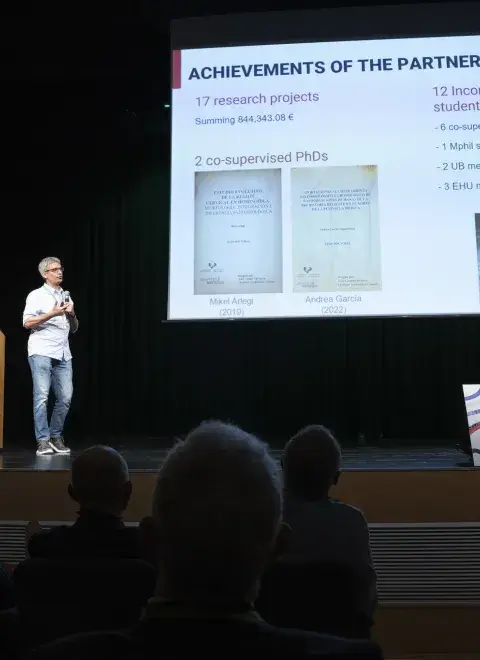
The programme combined oral presentations, posters, interactive sessions and keynote lectures. The opening keynote, delivered by Sonia Gómez Puente from Eindhoven University of Technology (the Netherlands), invited participants to reflect on how to design learning ecosystems that prepare people for an uncertain world and generate social impact. Mansi Sharma, from Ghent University (Belgium), brought the conference to a close with a reflection on how to reimagine the Master's thesis through Challenge-Based Education.
The presentations explored a wide range of CBE applications, from sustainability in university buildings, underwater robotics and artificial intelligence as a cognitive assistant to international cooperation, inclusion, health, the ecological transition and social innovation. The programme also showcased experiences in areas such as teacher education, engineering, health sciences, economics, communication and social sciences.
The poster sessions further enriched this exchange, providing additional opportunities to present and discuss projects. A polyphony of voices: six experiences of collaboration between universities and society One of the highlights of the first day was the interactive session A Polyphony of Voices, designed to give prominence to the different people and organisations involved in CBE projects. Through six experiences, the session brought together the perspectives of students, teaching staff and partner organisations.
As a collaborating organisation of the EHU’s CBE i3lab laboratory, Euskampus Fundazioa played a special role in organising and facilitating this session, helping to create a space for dialogue among the different stakeholders involved in the projects. The session was based on a key premise: the same experience can take on different meanings depending on who lives it. Listening to these different voices helps us recognise each stakeholder’s contribution, share the lessons learned and challenges encountered through collaboration, and identify new opportunities for transformation.
The six experiences presented illustrated the diversity of challenges that can be addressed through this methodology:
- Plastisphere and water quality: Amaia Zarrabeitia (EHU) and Sarah Itoiz (SUEZ Rivages ProTech) shared an experience connecting education and research to address environmental and public health issues.
- Low-cost solar-powered pumping: Unai Villena Camarero (EHU) presented an engineering challenge exploring technological solutions linked to sustainable development, in collaboration with TADEH and GISEL.
- Sustainability and co-creation: Maite Ruiz (EHU) and Oihane Gorordo Beaskoetxea (Provincial Council of Bizkaia) discussed collaboration between the university, public administration and students to develop solutions to the challenge of textile waste management.
- Engineering for sustainable human development: Maddi Garmendia Antin (EHU-ICLI) and Gorka Cubero (Zabalketa) presented an experience connecting engineering, development cooperation and education.
- UnicitiES 2030 and sustainable cities: Estíbaliz Sáez de Cámara Oleaga (EHU), Mariana Fernández Puche (REDS) and Mikel Regueiro Barreiro, an EHU student, shared an experience of collaborative innovation between the university and its surrounding territory.
- Indianoak and maritime heritage: Sandra Usín (EHU) and Rafael Zulaika (Indianoak-Ibaialde) showed how a communication plan can bring maritime history and heritage closer to society through a transatlantic expedition.
Following the presentations, participants exchanged views on three key questions: what students learn when faced with real-world challenges; how these experiences transform teaching practices; and what partner organisations contribute to, and gain from, taking part in these learning processes.
Euskampus: research, communication and cross-border collaboration through the EMPACT i3 project
Euskampus's contribution to the conference was also reflected in two presentations connecting Challenge-Based Learning with cross-border collaboration and research into multilingual practices. On the one hand, Pablo Rey, a participant in the i3 GIZARTEA programme and former Euskampus communications intern in the EMPACT i3 project, presented his experience and his Bachelor's Final Project, developed in collaboration with partner organisations.
Entitled “Breaking Down Barriers”: A Radio Feature on Cross-Border Cooperation between Euskadi and Nouvelle-Aquitaine, his contribution highlighted communication as a tool for raising the profile of cooperation projects and bringing their results closer to society. This experience illustrates how university learning can generate communication outputs linked to real-world collaborations and help make joint work between territories more visible.
On the other hand, Euskampus was represented in the poster session with the scientific contribution “Leveraging Multilingualism in Challenge-Based Education: Insights from the EMPACT i3 Project”, presented by Miren Itxaso Etxebarria (EHU). The research shares findings on linguistic diversity and multilingual practices in Challenge-Based Learning contexts within the cross-border project (Euskadi–Nouvelle-Aquitaine), EPACT i3, developed within the framework of the cross-border campus alliance between the EHU and the University of Bordeaux, Euskampus Bordeaux. The study examines how Basque, Spanish, French and English coexist and are used in these educational settings, as well as the role of language practices in participation, inclusion and the visibility of minoritised languages.
Together, these two contributions illustrate different ways of connecting universities, society and territory: from communicating and disseminating cross-border cooperation projects to researching the multilingual dynamics that accompany these learning processes.
Also noteworthy was the contribution by Cécile Cabasson, from the University of Bordeaux, with her presentation “Feeding Innovation: How Challenge-Based Education Shapes Talent in Sustainable Agri-Food”. It explored how Challenge-Based Learning contributes to developing the talent and skills needed to drive innovation in the sustainable agri-food sector. The initiative was developed within the framework of the EMPACT i3 project.
Likewise, also within the EMPACT i3 project, Jose Mari Etxabe presented the poster “The Basque Country through the Eyes of Wilhelm von Humboldt (1801)”, developed together with María Victoria Urruzola. The project involved supporting students in recreating the soundscape of the Basque Country at the beginning of the nineteenth century, bringing the historical and cultural context of the period closer to the public as part of an exhibition at the Basque Museum and Museum of Bayonne History.
Learning with the wider community to generate social impact
The experiences shared throughout the conference demonstrated that Challenge-Based Learning goes beyond bringing real-world problems into the classroom. It involves creating collaborative spaces where universities and society work together, combining knowledge and perspectives to address complex challenges.
The conference highlighted the diversity of CBE approaches and applications, as well as the role of students as active participants in their own learning and the value of partnerships with organisations, businesses, public administrations and social entities.
Two days of exchange and reflection reinforced one fundamental idea: connecting education with real-world challenges opens up new opportunities to transform both the learning experience and the relationship between universities and society.
Related news


Subscribe to Newskampus
And get our latest news in your inbox.