

Christine Couture y Aitor Gómez Olivencia durante su intervención presentando el LTC Human Shelters.
- Actualidad
New LTC Human Shelters, the unveiling of the last LTC at Euskampus Bordeaux Eguna
Euskampus Bordeaux Eguna 2026: Knitting Bridges Across Territories, Generations and History Held on 15–16 October at Ficoba in Irun,
Euskampus Bordeaux Eguna 2026 celebrated a decade of cross-border cooperation between the University of Bordeaux and the University of the Basque Country (EHU), with the designation of Human Shelters as the tenth Transborder Cooperation Laboratory (LTC), dedicated to the study of human evolution.
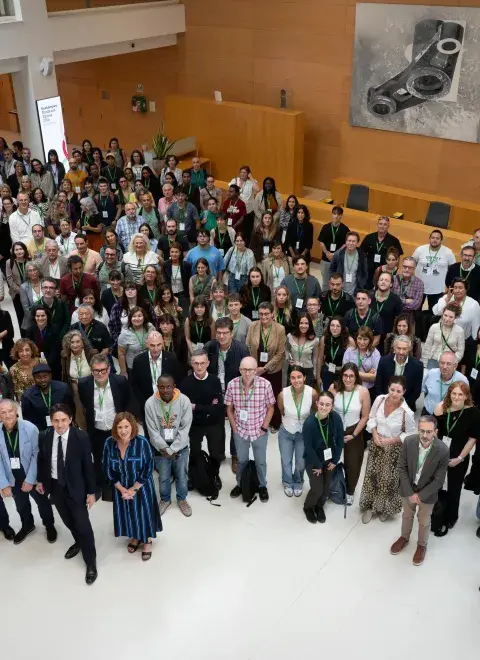
Some bridges connect riverbanks. Others bring together languages, research, disciplines and different ways of understanding the world. For two days, Euskampus Bordeaux Eguna 2026 turned Ficoba, in Irun, into a meeting place to celebrate a decade of encounters and collaboration between the University of Bordeaux and the University of the Basque Country (EHU). It was an opportunity to show how scientific research can transcend borders and build shared knowledge.
This year’s edition brought together around 260 participants and more than 60 early-career scientists, from master’s students to postdoctoral researchers. Under the motto Tejiendo puentes (Knitting Bridges), the event highlighted both the achievements of joint projects and the human and professional relationships that make them possible.
Human Shelters: a decade of collaboration exploring the story of humanity
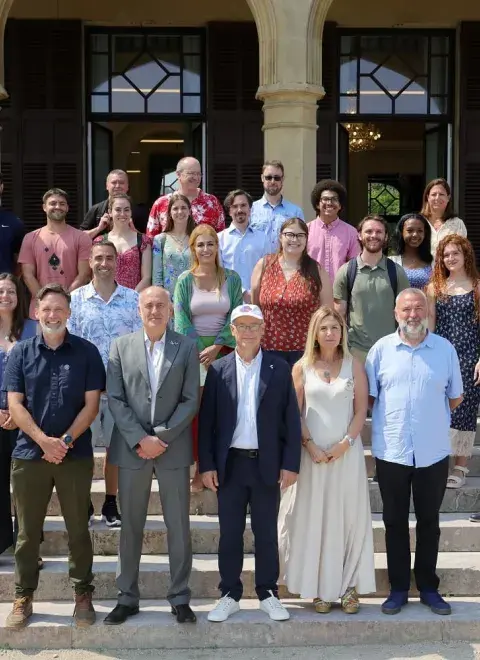
One of the key moments of the event was the designation of Human Shelters as the tenth Transborder Cooperation Laboratory (LTC) within the Euskampus Bordeaux cross-border campus. The laboratory brings together specialists from the University of Bordeaux and EHU in paleoanthropology and human evolution. Its team includes 17 researchers from Bordeaux and 19 from EHU.
The project explores how rock shelters can become archives of human history: places that preserve traces of past populations, their ways of life, and their relationships with different environments and geological contexts. It is led, among others, by Christine Couture, Professor of Paleoanthropology at the PACEA laboratory, associated with the CNRS, the French Ministry of Culture and the University of Bordeaux, alongside Asier Gómez-Olivencia, researcher at EHU.
Yet Human Shelters did not begin with its recent recognition. It is the result of more than ten years of scientific and personal collaboration. Asier Gómez-Olivencia explains that the joint work began with the study of human fossils discovered in south-western France and gradually expanded through joint publications, co-supervision of doctoral theses and the involvement of new researchers.
“It has been a long, fruitful and natural journey. It has evolved naturally,” says Gómez-Olivencia. This process enabled the team to grow and develop an interdisciplinary approach to the study of human evolution.
Looking ahead, the researcher returns to an image particularly fitting for an event dedicated to building bridges: “The road is well paved. Now we need to broaden our horizons, train new generations and enable new researchers to discover the research ecosystem on the other side of the Pyrenees.”
"Jaso dugun bermearekin eta laguntza ekonomikoekin hori posible izan da, eta, gainera, haratago joan gara, taldea handituz eta jende gehiago erlazioan jartzen. Eta, horregatik, oso-oso aprobetxagarria izan da, eta, dudarik gabe, erabakiorra, gero LTC-a lortzeko" (“Thanks to the support and financial assistance we received, this became possible. We were also able to go further by expanding the team and bringing more people together. The experience was therefore extremely valuable and, without a doubt, decisive in securing LTC status.”, added Gómez-Olivencia.
This movement of knowledge has a practical purpose: enriching research on both sides of the border. “What they learn at archaeological sites on the other side of the Pyrenees, they can bring back to the sites we are working on, in our case in the Basque Country,” he explains. He concludes with a phrase that captures the spirit of this cooperation: “It was a way of paving the future so that we can continue studying the past.”
The LTC Incubator: a catalyst for collaboration
The development of Human Shelters also highlights the importance of having structures that help turn scientific relationships into lasting projects. Before being recognised as an LTC, the team took part in the incubation phase, which helped consolidate the collaboration and expand its network.
Christine Couture recalls that the meeting between specialists from the two universities happened almost naturally, thanks to complementary expertise in a relatively uncommon academic field. Joint work on fossils found in south-western France became the starting point for a process that led first to the LTC Incubator and, after two years, to the recognition of Human Shelters.
“The LTC Incubator gave us two years to structure ourselves,” Couture explains. It provided an administrative framework, a solid organisational structure and support for developing cross-border research.
The researcher stresses that collaboration across a border involves more than sharing scientific goals. “We have different cultures, different languages and different ways of working, and I think the LTC Incubator taught us how to bring these together.” The ability to develop a shared way of working has been, in her words, “an extraordinary lever” for achieving LTC status.
Cooperation also requires work that is not always visible: coordinating teams, developing projects and creating administrative structures capable of sustaining them. “We need to work with one another. And that is what we have done within the LTC,” says Couture.
Looking ahead, Human Shelters aims to strengthen its academic dimension, develop new links with education and move towards joint training programmes, initially at master’s level. Passing knowledge on to younger generations will also be a priority, equipping them with the tools to continue and develop the laboratory’s research. "Il faut aussi qu'on assure la transmission de l'information et qu'on aille vers les jeunes générations qui vont nous remplacer demain. Et donc il faut qu'on leur donne les outils pour pouvoir nous remplacer demain et faire vivre tous les travaux autour de Human Shelters", Couture ha concluido.
Cooperation aligned with major scientific and societal challenges
The designation of Human Shelters is part of a broader history of cooperation between the Basque Country and Nouvelle-Aquitaine. Since 2015, the cross-border campus has recognised ten LTCs and supported a further fourteen projects through its incubation scheme, consolidating a scientific community that works beyond administrative boundaries.
During the event, the Basque Government’s Minister for Science, Universities and Innovation, Juan Ignacio Pérez Iglesias, highlighted the links between these laboratories and the Euskadi 2030 Science, Technology and Innovation Plan, particularly the Faros de Innovación programme and the Ikur strategy. He identified artificial intelligence, quantum science and technologies, decarbonisation, One Health, personalised and precision medicine, and demographic and social-health challenges as shared areas of interest.
The minister reaffirmed his department’s support for the LTCs, which have received a total budget of €3 million over the past six years. He also pointed to the opportunity to extend the Eurorregion’s cooperation experience to the scale of an Atlantic macro-region.
Bridges also carry memories
The scientific dimension of the event went hand in hand with a more personal and historical one. In Irun, beside the Bidasoa River, the border is not an abstraction: it forms part of the collective memory of those who crossed it, lived alongside it or grew up looking towards the other side.
Ricardo Díez Muiño, director of the Donostia International Physics Center (DIPC) and a native of Irun, recalled those who crossed the border in 1939, following the Spanish Civil War, in search of refuge north of the Bidasoa. The Santiago Bridge became a symbol of borders that, at certain moments in history, have divided people but have also offered a passage to safety and hope.
Joxerramon Bengoetxea, rector of EHU, recalled how listening to French radio and watching French television at his family home fuelled his curiosity about what was happening across the border. Two different memories illustrate how borders can be part of everyday life while also inspiring a desire to discover other realities.
In this sense, the bridges at the heart of this year’s theme are not intended to erase differences, but to make encounters across them possible. Languages, cultures and different ways of working do not disappear when people cooperate; they become part of what a team learns to share. Projects connecting knowledge and society
The Euskampus Bordeaux Eguna 2026 programme showcased the diversity of fields in which cross-border cooperation is taking place. The exhibition featured 28 posters and presented initiatives related to education and employability, research and innovation, internationalisation and territorial engagement, all classified in three itineraries: Care, Learn and Transform.
These included collaborations linked to the ENLIGHT European university alliance, joint master’s degrees, educational robotics, the social economy and neuroscience. The event also featured Bizi On, a programme connecting patients and researchers to help improve the quality of life of people with cancer in the Basque Country.
The second day included activities for the LTC community and presentations of eight cross-border projects in the MT173 format, with each project introduced in a concise 173-second pitch. The event concluded with a roundtable on the contribution of universities to building an Atlantic macro-region.
The participation of more than 60 early-career scientists also served as a reminder that the continuity of these networks depends on welcoming new generations, sharing experience and creating opportunities for education and research on both sides of the Pyrenees.
Building bridges to move forward
Euskampus Bordeaux Eguna 2026 celebrated a decade of encounters demonstrating that cross-border cooperation is built through time, trust and shared work. Human Shelters embodies this journey: a project born from collaboration between specialists, strengthened by a common support structure and committed both to deepening our understanding of the past and to preparing those who will continue to investigate it.
While the Human Shelters team studies rock shelters as archives of human history, the cross-border campus continues to build its own spaces for encounter. Bridges between territories, disciplines, languages and generations. Bridges that do not erase distances, but allow people to cross them and turn them into new opportunities for knowledge.
More about LTCs.
Related news


Subscribe to Newskampus
And get our latest news in your inbox.